
DECEASED. Beloved.
One word on a military form. One word carved in stone. The same son wrote both.

The Frances Series — This is part of an ongoing exploration of the life of Frances Kaplan (née Nevitsky), my grandmother — the woman I never got to meet. If you’re just finding her story:
This installment centers on Irwin, Frances’s older son — my father — and the silence that shaped him.
When Frances and Joseph got together, Julius and his family turned against them. That much my father made clear over the years — not in a single telling, but in pieces, the way family pain usually surfaces. Not a story with a beginning and an end, but a pressure that was always there.
I don’t know exactly what the turning looked like. I don’t know whether all communication stopped, or whether it continued in a form that was worse — whether Irwin heard things said about his mother, whether the hostility was spoken or just felt. What I do know is the result: my father did not have a relationship with his father. He did not have a relationship with his father’s family. However the break happened — whether it was a single rupture or a slow poisoning — it held for decades.
Joseph was the brother who took his brother’s wife. In the world they came from — immigrant, Jewish, bound by family loyalty and community reputation — what Joseph and Frances did was not just a personal betrayal. It was a rupture in the family’s public face. And the family’s response, whatever form it took, landed on the children too. Irwin and Allen grew up on the wrong side of something they hadn’t chosen and couldn’t fully understand.
Irwin carried this his whole life. He didn’t talk about it often, but when he did, it wasn’t sadness. It was anger. Sharp and compressed, calcified over decades. He was angry for himself. For being cast aside by a family that let whatever had happened between the adults determine what the children deserved. But he was angry for his mother, too. The way the Kaplans treated Frances — whatever they said about her, however they dismissed her. That wasn’t just a slight against her. It was a slight against him. What you say about a person’s mother is a reflection on the person themselves. They are made from that person. An attack on the parent is an attack on the child. And my father felt every bit of it.
In January 1952, Irwin applied for Officer Candidate School at Fort Benning. He was twenty-two years old. The application required him to list his parents. Under his father’s name, he wrote: Julius Kaplan. DECEASED. Julius was not dead.
I'm Fran — and I believe your family's past is still speaking. Every week at The Past, Still Present, I explore what the records really tell us: not just names and dates, but the lives behind them. I use AI and Notion to slow the research down and look more closely — and I share my own family stories along the way. If you've ever felt that your ancestors deserve more than a family tree, you're in the right place.
He was alive in the Bronx, cutting fabric, lodging in other people’s homes. He would live another twelve years. But Irwin wrote the word anyway — on a government form, in a military file, in black ink. It was not a clerical error. It was a declaration. To Irwin, the man who had let his family cast out his own sons was already gone.

I keep thinking about what it takes to write that word. Not in a diary, not in a letter to a friend, but on an official document — one where lying carries consequences. Irwin was not a reckless person. My father was careful, principled, someone who did things by the book. And yet here he is, twenty-three years old, telling the United States Army that his father is dead. The severed relationship must have been so painful that the lie felt closer to the truth than the truth did.
But that is not where this story ends.
Julius died on February 22, 1964, aged sixty-four, in Manhattan. And despite everything, the estrangement, the silence, the word DECEASED written in a military file one decade earlier, it was Irwin who went to the hospital in his father’s final days. The visit was brief. They did not reconcile in any dramatic way. But Irwin showed up. After a lifetime of denial, he walked into that room.
And then he did something I still can’t fully explain.
Irwin purchased the gravestone. He arranged the burial. And he chose the inscription. The stone reads:
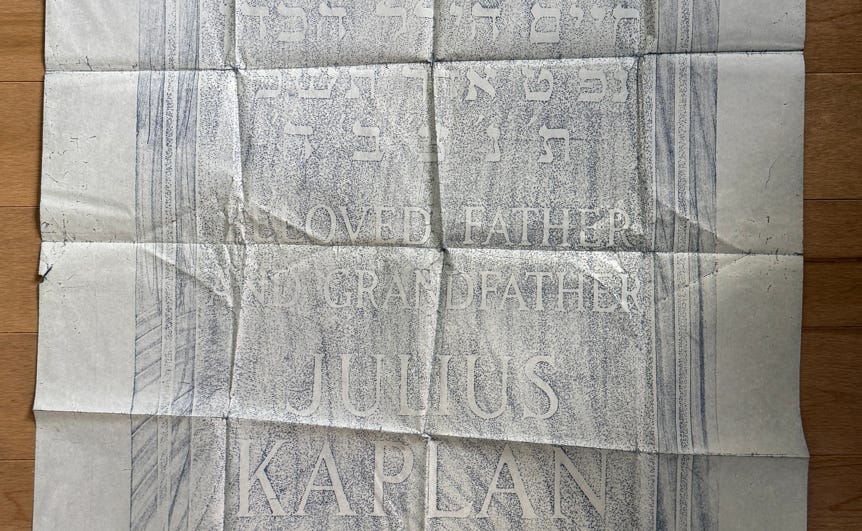
Beloved Father and Grandfather Julius Kaplan Died Feb. 22, 1964 Aged 64 Years
In Hebrew, below: Yehuda, son of Chaim Hillel, a Cohen.
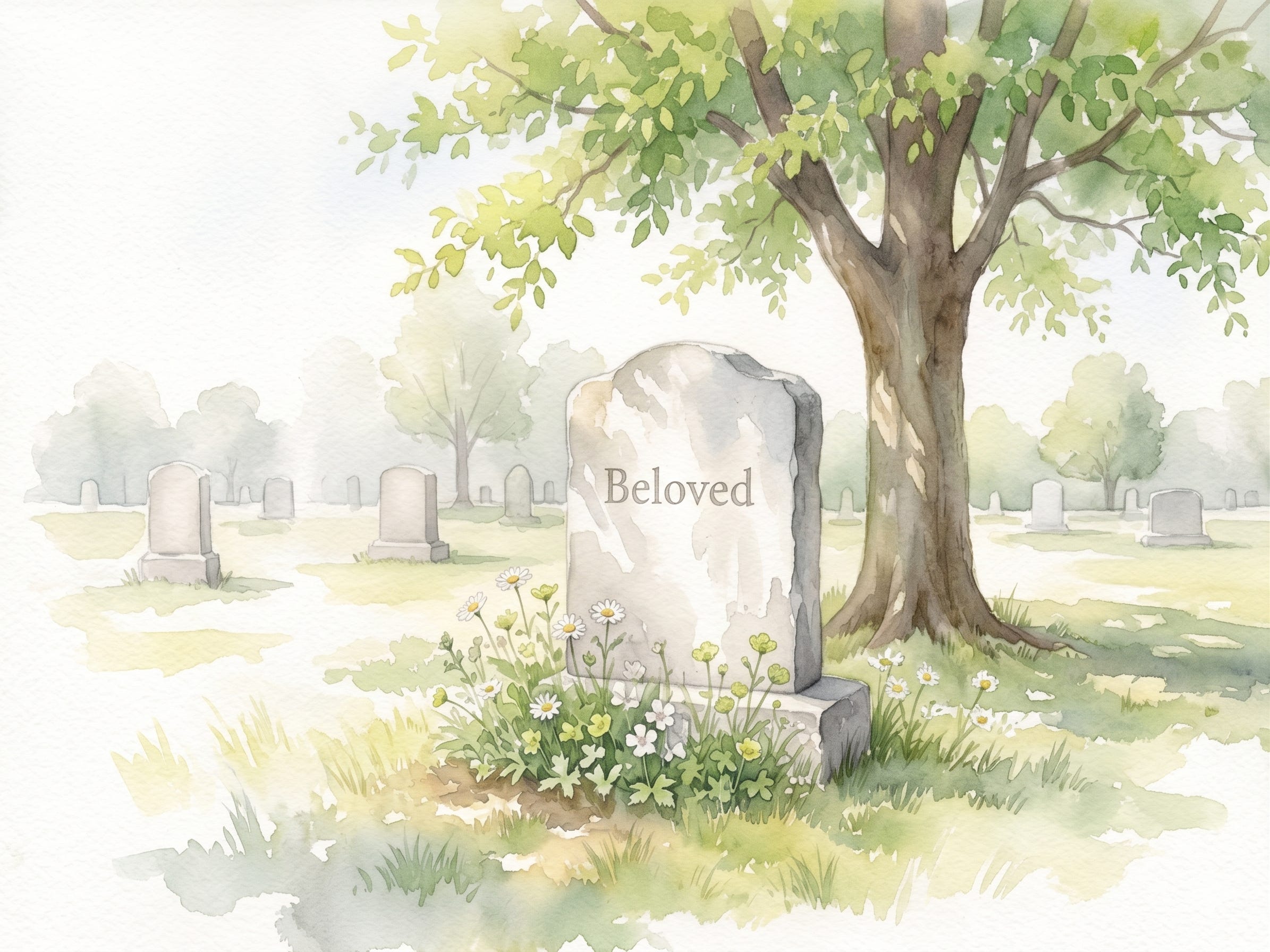
Beloved. The man who wrote DECEASED on a government form chose the word beloved when it was time to write something in stone. I don’t think those two things cancel each other out. I think they’re both true. Held in the same body, by the same son, for the same father. The anger was real. The silence was real. And so was this.
Three weeks after Julius died, a letter arrived.
It was from Albert Becker — Julius’s nephew, the son of his sister Jennie. Albert had gone through Julius’s personal effects. He had only Irwin’s address. He wrote to both brothers.
Dear Irwin and Alan,
I do not know if you remember me, but I remember you. I will admit, however, that the recollection is rather vague.
My purpose in writing to you is just to let you know that you have got a family on your father’s side, and I just want to extend my hand to you and offer the warmth which is and has been in my heart for you two boys.
A family. A whole family, right there in the city, who felt warmth toward them. Warmth that my father never felt while Julius was alive.
But the letter held something else. Among Julius’s personal effects, Albert had found a letter — from Irwin. Irwin had written to his father years earlier, during a previous heart attack. Albert called it “beautiful.” Julius had received it, read it, kept it among his things. And never responded.
I suppose I will never understand why, after receiving this beautiful letter, he never did anything about it, Albert wrote. But I really feel that he actually died when he got that attack. Perhaps he may have felt that this was his crowning injustice.
I’ve turned that phrase over many times. His crowning injustice. I think Albert meant that the letter itself, the proof that his son still loved him, was the cruelest thing life had dealt Julius. Not the betrayal. Not the estrangement. Not losing Frances or the years of silence. The crowning injustice was that love had survived all of it, and he still couldn’t reach it. His son’s words were right there in his hands, and whatever had calcified inside him, whatever mix of shame and pride and paralysis, wouldn’t let him answer. He kept the letter. He couldn’t keep the connection. And that, more than anything else, may have been the thing that broke him.
So there it is. Irwin tried. Somewhere before the end, he reached across the silence and wrote his father a letter. And Julius kept it. But he couldn’t answer it. The son who wrote DECEASED also wrote something beautiful, and the father who received it let it sit in a drawer until someone else found it after he was gone.
Albert closed by telling Irwin and Allen that they had “a pretty large family” who felt the same way he did. Warmth that had existed for decades. Warmth that only became words on a page after Julius was dead.
Three and a half months after the burial, weeks after receiving Albert’s letter, Irwin went to the cemetery where his father was buried. His son remembers the day. Irwin brought a large piece of paper and pressed it against the face of the stone. He made a rubbing — a physical tracing of the inscription, letter by letter, to take home and keep.
I think about what he knew by then. He knew his father had kept his letter. He knew Julius had read it and held onto it and never written back. He knew there was a whole family out there who had cared about him and his brother and said nothing for decades. And he went to the gravesite anyway. He pressed paper to stone and traced the word beloved — the word he himself had chosen. And brought it home.
A man who felt nothing wouldn’t buy the gravestone. A man who had truly erased his father wouldn’t go back with paper and charcoal to preserve the words. But Irwin did. By then he knew his father had done something similar. Julius kept the letter in a drawer. Irwin kept the rubbing in a drawer. Two men, holding onto proof of something they couldn’t say out loud.
I have the rubbing. It’s here, in my house, passed down like the silence itself. An artifact of a grief that never found its proper name.
I found Albert’s letter in my father’s papers after he passed. It was one of the most important things I found — because it gave me names. It gave me the Kaplan family that my father never talked about. Through that letter, I was able to find siblings, cousins, an entire branch of the family that had been invisible to me my whole life. Not because they didn’t exist. Because the silence was that complete.
But the letter my father wrote to Julius — the one Albert called “beautiful,” the one Julius kept among his things — I never found it. I don’t know if Albert sent it back to my father or kept it himself or if it was simply lost. All I know is that it wasn’t there. I went through everything. The rubbing was there. Albert’s letter was there. But my father’s own words to his father, the ones he wrote during a moment of reaching out, of setting aside decades of anger to say something honest — those are gone. I will never read them. My father didn’t show that kind of vulnerability to us very often. And one record of it that existed has disappeared, the way so many things in this family have disappeared. Kept by one person, unknown to the next, and eventually lost to the silence that outlived them all.
And my father — the man who had written that beautiful letter to Julius, who had gone to the hospital, who had bought the stone, who had chosen the word beloved, who had gone back with paper to trace it. In his own final days, he echoed his father’s silence in ways I am still reckoning with. The wound didn’t just pass down. It taught the next generation its shape.
DECEASED. A beautiful letter, kept but never answered. Beloved. A rubbing made by a son who now knew his father had kept his words. A family that existed but never reached out. And then the same silence, repeated, one generation later.
Frances married into this family at sixteen. Whatever she carried into that marriage — the instability, the loss, the fractured childhood - she carried it forward. Not because she chose to, but because the choices made around her created fractures that outlived everyone involved. Her children inherited every unresolved piece. And their children inherited what was left.
But Frances is not finished. There are still her final years with Joseph, the life they built together after the rupture. There are still two sons growing up in the wake of it. There is her illness, her death, and what happened to the family she left behind. The silence didn’t start with Julius’s gravestone, and it didn’t end there either.
Next time, we go back to Frances.
Thank you for reading! Every week at The Past, Still Present, I share research, tools, and reflections for anyone who believes family history is more than a tree. Subscribe to receive each article directly in your inbox.
References
DA AGO Form 93 (1 Mar 51), Application for Entrance to Officer Candidate School, Irwin Hyman Kaplan, US 51166936, dated 11 June 1952; includes DD Form 398 (1 Nov 50), Statement of Personal History. Privately held by the author.
1940 U.S. census, Bronx County, New York, population schedule, New York City, enumeration district (ED) 3-1258, sheet 61A, dwelling —, family 52, Julius Kaplan; digital image, Ancestry.com (https://www.ancestry.com/imageviewer/collections/2442/images/m-t0627-02491-00851?pId=3461316); citing National Archives and Records Administration microfilm publication T627, roll 2491.
1950 U.S. census, New York County, New York, population schedule, New York City, ED 31-845, sheet 2853, line —, Julius Kaplan; digital image, Ancestry.com (https://www.ancestry.com/imageviewer/collections/62308/images/43290879-New_York-043216-0027?pId=285659619); citing National Archives and Records Administration.
“New York, New York, U.S., Death Index, 1949–1965,” database entry for Julius Kaplan, age 64, certificate no. 3973, died 21 February 1964, Manhattan; digital image, Ancestry.com.
Julius Kaplan gravestone (died 22 Feb. 1964), inscription “Beloved Father and Grandfather”; rubbing made by Irwin Kaplan. Privately held by the author.
Albert Becker to Irwin and Alan Kaplan, letter, 13 March 1964. Privately held by the author.
Fran, this is building and building! How fascinating! Family stories are never simple are they - there is a complexity that can be surprising the more we unravel them.
Thank you for sharing this journey with us.
Wow Fran, this is an extraordinary piece of family storytelling. The tension between “DECEASED” and “Beloved” captures how love and hurt can coexist without resolution. What lingers most is not the rupture itself, but the silence around it, and how powerfully that silence can echo across generations.