
The Neighborhood
Out the front door and onto the block — the second of a three-part series with genealogist John Cass, using his Neighbor History Research method to bring my family back to life.

The Anne Series. This is part of an ongoing exploration of the life of Anne Gertrude Epstein (Mooney), my maternal grandmother, the keeper who held a crowded table together, and the people she loved but could not keep. If you’re just finding her story:
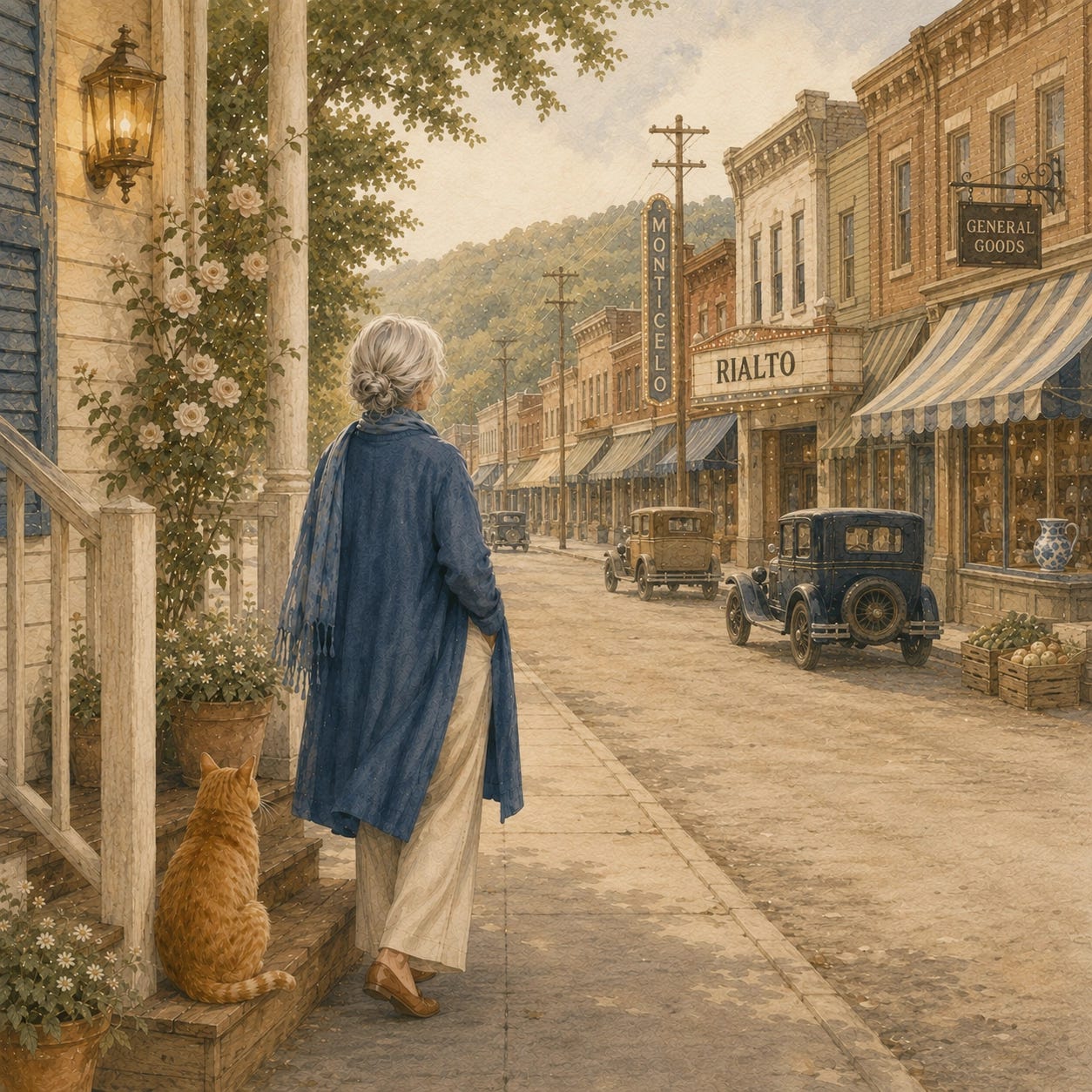
Out the front door
A man stopped my great-grandfather in the bank one day to tell him his daughter was going to Karl Marx classes.
Joseph Epstein was a Russian immigrant carpenter in a Catskills village of thirty-five hundred people. He had crossed an ocean, built a life with his hands, and become a landlord with four families under his roof — a man with every reason to care what his neighbors thought of him. He shrugged. “This is a free country,” he said. “She can do what she wants to do.”
The daughter was Anne, my grandmother. That a girl her age could walk into a Marx lecture in Monticello, New York, in the late 1920s — and that word of it reached her father in the bank, of all places — tells you most of what you need to know about the block she grew up on.
I’ve come to think of that shrug as the real inheritance. Not the house, not the business — the permission.
Last time, we stayed inside the house: the big frame house at 372 Broadway, the four families living under Joseph’s roof, and how briefly he got to stand at the top of the life he had built. This time, we step outside.
A house is only half of a childhood. The other half is everything a girl passed on her way down the front steps: the shops and the neighbors, the school and the shul, the movie palace, and the hall where the whole town argued. So let’s look again — this time out the door and onto the streets of Monticello, with Anne as our guide.
I’m Fran — and I believe your family’s past is still speaking.
This piece walks the block my grandmother grew up on and asks what a neighborhood gave a carpenter’s daughter permission to become.
That’s the work I do every week at The Past, Still Present using AI and Notion to slow the research down, look more closely, and share my own family stories along the way. If you’ve ever felt that your ancestors deserve more than a family tree, you’re in the right place.
The shops on Broadway
Broadway was the immigrant spine of Monticello. Anne came of age on it across the whole of the 1920s — a girl of ten or eleven when the decade opened, a young woman of twenty-one when it closed — and she could have knocked on almost any door on that street and found a story that rhymed with her own. By 1930 the census had caught her at her first full-time work, bookkeeper for an insurance company. The jobs that came before it slipped past the record entirely, remembered only by Anne herself: a stretch at a laundry, possibly the American Laundry run by Phillip Kaplan just a ten-minute walk from the house, and the odd seasonal work a resort town hands its teenagers. Her own memory is the only place they survive, and memory is a source too.
As Anne stepped out her door and turned left, she passed Ralph Coddington, the garage mechanic at 370 Broadway, one of the few non-Jewish families on the stretch.
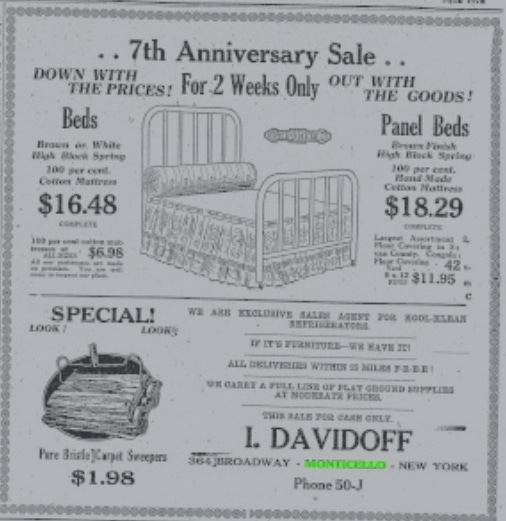
Then came Davidoff’s Furniture two doors down. Israel Davidoff had come from Poland in 1904. Beside the furniture store stood Saul Streifer’s grocery, where Nettie most likely picked up the fresh ingredients for the family’s meals. Streifer was a Pole too, who had arrived a few years after Davidoff.
In the opposite direction were the Adlers, Russians like her parents, who sold dry goods, a small neighborhood shop where you might go for the cloth needed to make your own dress. On the other side of the Adlers was Murray Gitlin, a grocer, and Ben Isacson, a butcher.
The butcher shop is the one stop Anne specifically recounted to me when I interviewed her for a college paper:
“My mother went down to the butcher shop. They killed a cow. She’d make patcha (jellied calf’s foot)...She would make beet soup. She would make all kinds of things from a cow. That’s how far it went. My mother knew how to do that.”
This small stretch of Broadway was Monticello in miniature. The village had drawn Jewish immigrants up from the city and over from the old country, families who had come to build a life better than the one they had left behind, and they had gathered here thickly enough to make a world of their own. They had arrived between roughly 1891 and 1912, from Russia, Poland, Austria, Romania. Down the census column the enumerator wrote the same word again and again. Yiddish. Yiddish.
It was a street where everyone was climbing, from steerage to a storefront, from a rented room to a deed, and everyone could watch everyone else do it.
For Anne, coming of age on that block, it must have felt like belonging in the plainest sense. The people she passed were versions of her own family. They shared a similar immigration journey, kept many of the same customs, and answered the census taker in the same mother tongue she spoke at home. A young woman walking Broadway was not the odd one out or the only one of her kind. She was one of many, part of a thriving Jewish community that had made a small Catskills town its own.
The immigrants’ children head to college
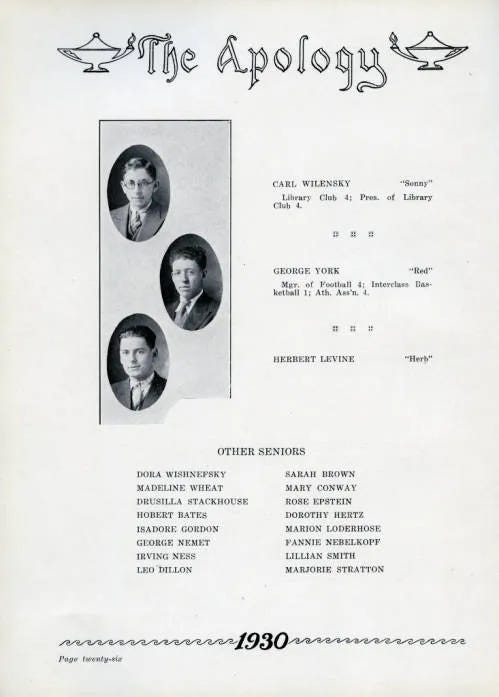
In June 1930, Rose Epstein, Anne’s younger sister, was a graduating senior at Monticello High School. The yearbook that year was called The Apology. Rose’s name (no photo unfortunately) was listed among the “Other Seniors,” but the class prophecy gave her a future anyway: it imagined her in 1950 as “Rose Epstein, the noted philanthropist.”
The Republican Watchman ran the real plans on June 13, 1930, under a headline that could have been written for the whole decade: “Graduates Plan Future Careers. Girls Favor Teaching.” Rose, the paper reported, “has made application for admission to the New York State College for Teachers” in Albany.
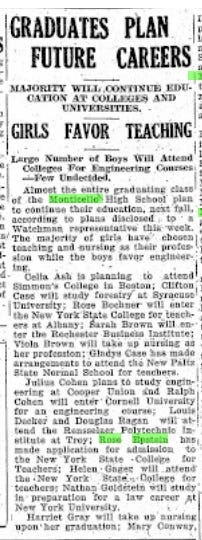
She was in good company, and the company is the point. Ralph Cohen to Cornell for engineering. Julius Cohen to Cooper Union. Nathan Goldstein to NYU for law. Rose Bochner and Helen Gager to the teachers’ college in Albany alongside Rose Epstein. Sarah Brown to the Rochester Business Institute. Celia Ash to Simmons.
Cohen, Goldstein, Bochner, Ash, Epstein. A generation earlier their parents had reached this country with a language, a trade if they were lucky, and very little else. Now their children were filling out applications to Cornell and Cooper Union and Simmons, and the local paper was printing it as ordinary news.
The families of Monticello had raised, in a single generation, a graduating class bound for the professions.
None of that was an accident. It was the whole reason their parents had come. Joseph Epstein worked with his hands and put what he earned into a house with four families under its roof; the men and women up and down Broadway put theirs into groceries and dry goods and furniture. Different work, one purpose — children who could sit for the entrance exams they themselves never could. The class of 1930 was what all of it had been for. A generation raised on that street was stepping into a wider world, into lives their parents had been able to picture only from a great distance, and that picture was finally coming true.
Hebrew school and the right to quit it
While Rose was filling out her applications in 1930, Anne’s own schooling had ended years earlier and it had ended on her terms. Somewhere in her girlhood, her parents sent her to Hebrew school.
For a family like theirs there was only one option in town at the time, the Orthodox synagogue on Landfield Avenue built in 1909. Anne’s parents sent her there for Hebrew school, and she quickly formed an opinion about her experience. She told the story herself more than sixty years later:
“I can remember going to school, and then they’re putting me in Hebrew school. And when I saw those children... how they were carrying on and how the rabbi was taking care of them, I told my father, ‘I want no part of it.’ So he taught me whatever I knew about Jewish letters, and I used to read, and I even wrote to my mother in Jewish, and she would write to me.”
By “Jewish letters” she meant Hebrew. She learned enough to read, then lost most of it as an adult, the way rote lessons fade when nothing keeps them alive. Yiddish was different. Yiddish was the daily language, the one she communicated with her mother in for the rest of Nettie’s life.
There is a tenderness in that memory worth pausing on. Anne wanted no part of the rabbi or his classroom. A girl told a devout mother and a father raised on the old letters that she wanted no part of Hebrew school, and they let her stop. They did not insist. In a house where Nettie kept the faith almost single-handedly, Anne was still trusted to decide this one for herself. It is the earliest sign I can find of the thing this family kept giving her: the freedom to make up her own mind.
The hall where the town argued
The walk that may have mattered most led to the Workmen’s Circle Lyceum.
The Arbeter Ring, the secular Jewish labor fraternity, kept a hall in Monticello, and the hall kept a library and a lecture schedule. Whether Anne ever sat in that room for a lecture I can’t prove; that’s my inference, not the record’s. But the Lyceum was where Monticello went to argue.
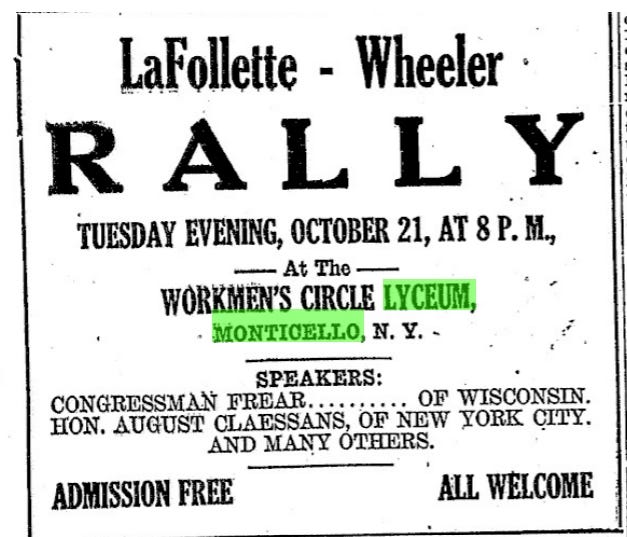
In January 1927 the branch filled it for a tenth-anniversary banquet, two hundred strong, with a Socialist speaker from the city as guest of honor. A few years before that, in the fall of 1924, the same hall opened its doors for a LaFollette-Wheeler rally, a third-party run for the presidency. “Admission Free. All Welcome.”
That rally is easy to misread from here. Robert La Follette was a Republican senator from Wisconsin, running on a third-party Progressive ticket with a Democratic senator, Burton Wheeler, as his running mate, endorsed by the Socialist Party and the railroad unions alike. He took nearly a sixth of the national vote. It was the ordinary arithmetic of the era: prices outrunning wages, workers organizing for the right to bargain, and progressive politics running through both parties. Theodore Roosevelt had made his own Progressive run only twelve years earlier, and for much of the 1900s and 1910s it was Republicans, more than Democrats, pressing for the reforms we would now call social democratic. The lines we assume were always hard were still being drawn. So when Monticello filled that hall, it was not a fringe gathering. It was a town arguing about wages, prices, and what a person’s work was worth, the argument a carpenter and his daughter could walk into on any given evening.
Anne did more than pass that world on the sidewalk. She walked into it. She remembered going to hear the big ideas argued out for herself:
“I used to go to Karl Marx classes and listen. I wanted to know what the heck it was all about. It didn’t influence me, though, at all. One man met my father in the bank and he said, ‘Do you know your daughter is going to Karl Marx classes?’ My father says, ‘This is a free country. She can do what she wants to do.’ And how do you like that?”
There is a great deal in that small memory. A carpenter’s daughter in a Catskills town of thirty-five hundred people, sitting through Karl Marx classes because she “wanted to know what the heck it was all about.” Curiosity, not conversion. The freedom, once again, to reason the world out for herself. She came of age not in the shul but in the lecture hall.
And she was not the only one listening. When Rose’s class wrote its prophecy in 1930, imagining where everyone would be twenty years on, they set a scene on a street corner in a nearby town: “A block farther we saw a crowd assembled... The first speaker was a communist leader.” They gave the part to a classmate, Leo Dillon. The joke only works if every student reading it already knew what a soapbox radical looked like and had probably stopped to listen to one. These were seventeen-year-olds in the Catskills, and that was simply part of the scenery.
The Rialto and the rollercoaster
Monticello was not only a county seat and an immigrant Broadway. It was a resort town, one of the bright hubs of the Catskills, and every summer it swelled with vacationers up from the city looking to spend on a good time. A place that size did not build a movie palace and an amusement park for its few thousand year-round residents. It built them for the season, and the local young people got to enjoy them the rest of the year too. For Anne and Rose, two sisters coming of age on that block, the pleasures of a booming resort were close at hand and plenty of them.
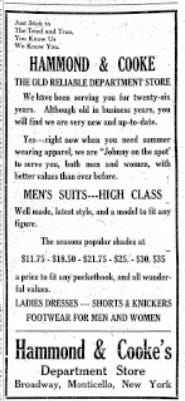
For a graduation dress, or any dress, there was Hammond & Cooke, the department store that anchored Monticello’s Broadway and that the family still remembered generations later. It was where you bought the thing you wore to be photographed for the yearbook.
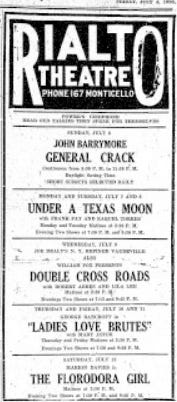
On a summer evening, Anne and Rose could walk up to the Rialto, the movie palace that opened in 1921 with a pipe organ and drew crowds from across the county. In one July week its marquee ran John Barrymore in General Crack, a musical romance called Under a Texas Moon, a mid-week night of live vaudeville, and George Bancroft in Ladies Love Brutes. The talkies reached Monticello within months of New York. For the price of a ticket, a carpenter's daughter sat in the dark with Hollywood.
And at the foot of Wheeler Street stood the thing the whole county talked about. The Monticello Amusement Park opened in 1923 and billed itself, without apology, as “the Coney Island of the Catskills.”
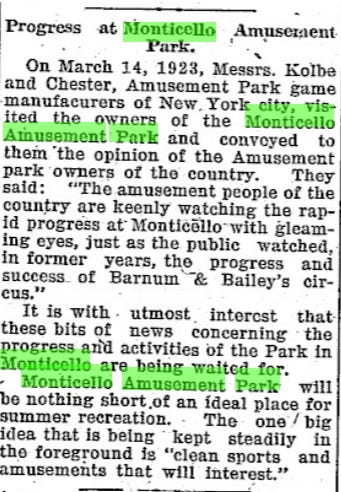
For a village of a few thousand people, it was an extravagant thing to have at the edge of town. There was a midway of games and concessions, a swimming pool, a carousel, and one of the largest roller coasters in the state, a wooden giant you could hear from blocks away. A grand dance hall anchored the grounds and doubled as a boxing arena, drawing crowds big enough that the lightweight champion Benny Leonard was seen on the grounds. All summer the park ran on the vacationers who flooded the Catskills, and on the local young people it hired each season, girls among them, to keep it running.
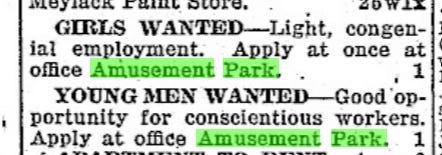
One of those young people was Anne. She sold tickets at the roller coaster one summer, making change in the booth while the resort crowd climbed aboard and screamed down the hills. In 1932 the dance hall burned and never reopened, and the park did not long outlast it. But in her teens it was the beating heart of the town’s fun, and for a season she stood inside it, not watching from the edge but helping to run the ride.
City and country in one town
Almost everything New York City could offer a young Jewish woman in the 1920s was waiting within a few blocks of Anne’s door. The talkies. The lectures. The arguments. The dance-hall lights. And all of it sat inside the slower, safer scale of a country town, where the merchant down the block knew your father and the census taker wrote your family’s language beside your name.
She grew up in that overlapping world. City and country. Old country and new. Her mother’s Sabbath and her own secular certainties. A class of merchants’ children applying to Cornell in the very season the economy was about to fall out from under them.
One thread ran straight between the two worlds, and for a season Anne held it herself. She sold tickets at the bus depot, the town’s daily tether to the city, and the job doubled as her way of sending food down the line to relatives still struggling in the New York the family had left behind. The same buses that carried vacationers up to the mountains carried her packages back the other way, a girl of the Catskills feeding the kin who had stayed in the tenements, along the very road that had once brought her parents north.
That is what was in the air on Broadway: ambition and memory, in equal measure, on a street you could walk end to end before supper.
And running underneath all of it, the thing this family kept giving her was the freedom to make up her own mind. The block argued, the shul beckoned, the lecture hall filled its seats, and Anne was trusted to decide for herself which room to walk into. That is what her father was protecting in the bank that day, and I think it is the piece of her that traveled furthest down the line.
So let me leave you with what I keep asking these records. If you walked out your own grandmother’s front door, who would you meet on the block? The neighbors, the shopkeepers, the languages traded across the counters, the whole small world that shaped her before you were ever born. Start there. That is where she is still waiting to be found.
And then ask the harder one: what did that world permit her to be? Because whatever it gave her — or refused her — some of it is still moving through you.
Next time, we widen the lens one more turn — past the block to the whole Catskills world of migration, boom, and bust that made Monticello what it was, and that drew Anne’s family to it in the first place.
Thank you for walking Broadway with Anne, from her front steps past the butcher shop all the way to the ticket booth at the roller coaster. The freedom she was given to choose which room to walk into never turns up in a record, and digging until I can see it is the whole reason I keep reading the neighbors.
Every week I share research, tools, and reflections for anyone who believes family history is more than a tree. Subscribe to receive each new piece in your inbox.
A note on the method: this is the second of three pieces built with the guidance of genealogist John Cass, using his Neighbor History Research approach — reading a family through the people, addresses, and records that surrounded them. Part one stayed inside a single house and the people the census found under its roof. This time the lens widened to the block around it: the neighbors, the shops, the school, and the hall where the town argued. Next it widens once more, to the town itself and the whole Catskills world of Jewish migration, boom, and bust that shaped them all.
Sources
1930 U.S. census, Sullivan County, New York, population schedule, village of Monticello, town of Thompson, enumeration district (ED) 53-34, sheets 3-B through 4-B, Joseph Epstein household and neighboring Broadway households; enumerated by Charles J. Kurz, April 1930.
Anne Epstein Mooney and Frances Kaplan Davis, “An Interview with Anne Epstein Mooney and Frances Kaplan Davis,” interview by Fran Davis, 1988; video recording privately held by Fran Davis.
I. Davidoff Furniture Store advertisement, Republican Watchman (Monticello, New York), 30 April 1926, p. 5; digital images, NYS Historic Newspapers (https://nyshistoricnewspapers.org : accessed 1 August 2026).
The Apology (Monticello, New York: Monticello High School, 1930), p. 26, “Other Seniors,” and class prophecy; digital images, New York Heritage Digital Collections (https://nyheritage.contentdm.oclc.org/digital/collection/libertyhs/id/17855 : accessed 24 July 2026).
“Graduates Plan Future Careers; Girls Favor Teaching,” Republican Watchman (Monticello, New York), 13 June 1930, p. 12; digital images, NYS Historic Newspapers (https://nyshistoricnewspapers.org : accessed 1 August 2026).
“History,” Landfield Avenue Synagogue (https://www.landfieldavenueshul.org/about-4 : accessed 24 July 2026).
“Workman’s Circle Tenth Anniversary,” Republican Watchman (Monticello, New York), 28 January 1927, p. 8; digital images, NYS Historic Newspapers (https://nyshistoricnewspapers.org : accessed 1 August 2026).
LaFollette–Wheeler rally advertisement, Republican Watchman (Monticello, New York), [October 1924], page unknown; digital images, NYS Historic Newspapers (https://nyshistoricnewspapers.org : accessed 1 August 2026). The advertisement gives only “Tuesday Evening, October 21”; the year is inferred from the 1924 Progressive ticket and the calendar, and the issue date remains unconfirmed.
“Robert M. La Follette,” Wikipedia (https://en.wikipedia.org/wiki/Robert_M._La_Follette : accessed 1 August 2026).
Hammond & Cooke advertisement, Republican Watchman (Monticello, New York), 4 July 1930, p. 4; digital images, NYS Historic Newspapers (https://nyshistoricnewspapers.org : accessed 1 August 2026).
Rialto Theatre advertisement, Republican Watchman (Monticello, New York), 4 July 1930, p. 8; digital images, NYS Historic Newspapers (https://nyshistoricnewspapers.org : accessed 1 August 2026).
“Monticello Amusement Park: Some History,” New York Almanack, April 2022 (https://www.newyorkalmanack.com/2022/04/monticello-amusement-park/ : accessed 24 July 2026).
“Progress at Monticello Amusement Park,” Republican Watchman (Monticello, New York), 23 March 1923, p. 5; digital images, NYS Historic Newspapers (https://nyshistoricnewspapers.org : accessed 1 August 2026).
“Girls Wanted” and “Young Men Wanted” advertisements, Republican Watchman (Monticello, New York), 28 May 1926, p. 5; digital images, NYS Historic Newspapers (https://nyshistoricnewspapers.org : accessed 1 August 2026).
Thank you for this, and for all of your stories. I have followed this series and the last with great interest. My husband’s great grandparents emigrated from Russia, Galicia and Hungary in the late 1800’s, so I have learned a great deal from your research. Many thanks!
Amazing, Fran!! I loved the old advertisements too - there is something about those that always make the moment they came from seem more real. I love that Anne was allowed to decide her own path and explore her own thoughts - I think that may have been very rare in that era?!
The region my family came from had a monthly Photo News that has been mostly digitised. I love searching out names in it and finding out what dress my great-nana wore to a fancy event or how my grandad was fined again for cycling at night without a light. They even advertised when people were travelling away out of town for a holiday! The times seem so much simpler and so sweet because of that.