
The Thinking Is Mine
Substack turned on AI detection. I would rather tell you exactly how I work than let a number tell you first.

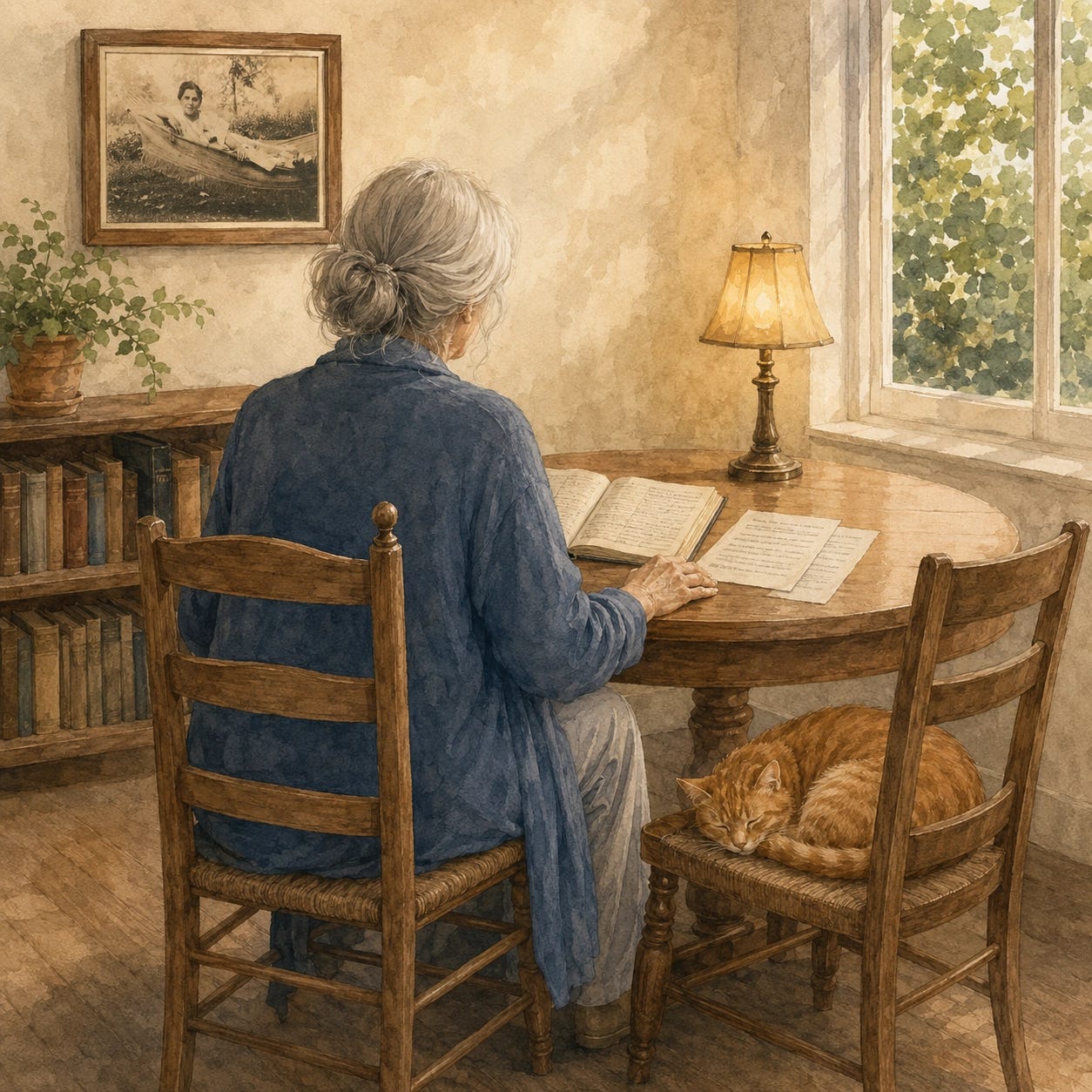
I was in the middle of writing about my father, about silence and gravestones and a letter kept in a drawer, when I stopped and said something to my AI collaborator that surprised me.
These emotional words are not mine.
I meant it. The article was moving. It was honest. It said things about my father that I had felt for decades but never put into language that precise. And the language had come from a conversation, one where I talked and it listened and I corrected and it reshaped, until something emerged on the page that brought tears to my eyes.
And then the guilt hit.
I’m Fran — and I believe your family’s past is still speaking.
This piece is my honest accounting of what AI does and does not do when I write about my family, and why the records, the reading, and the willingness to look are still mine.
That’s the work I do every week at The Past, Still Present — using AI and Notion to slow the research down, look more closely, and share my own family stories along the way. If you’ve ever felt that your ancestors deserve more than a family tree, you’re in the right place.
I know this feeling well by now. It comes in waves. One moment I’m elated. Look at this thing we made, look at how it captures exactly what I meant. And the next I’m questioning everything. Is this really mine? Am I cheating? If the sentences came from a machine, does the story still belong to me?
I’ve had this conversation with my husband, with friends, with myself and with AI. And I keep landing in the same place. I don’t have a clean answer. But I have a real one.
There are a lot of people right now who will stop reading the moment they learn AI was involved. Who will dismiss the story, the craft, the years of research, all of it, because of the tool I used to get the words onto the page. I understand that impulse. We are all trying to figure out where the line is, how much help is okay, what still counts as yours, and when a creation stops being yours at all. Nobody has a clean answer to that yet.
I started this article weeks ago, and then I let it sit. It has been circling my mind since the first time I opened a conversation with an AI and watched my own thinking come back to me clearer than I had managed on my own. I expected a tool that would help me write. I did not expect one that would teach me something about myself. I kept adding to this article and I kept not publishing it. I wasn't sure I wanted to say any of this out loud.
Then, on July 21, Substack turned on AI detection. Any reader can now run a scan on a piece of writing and get back an estimate of how much of it a machine wrote. My first reaction was not principled. It was a flinch, the fear of my work coming back with a high AI-assisted score, of being sorted into the lesser than pile, of years of records and reading and sitting with hard material getting waved off by a percentage. I sat with that flinch for a few days. Then the fear turned into something else. I would rather tell you exactly how I work than let a number tell you first.
In her essay “The Art, the Artist, and the Artificial Intelligence,” Daria Markava argues that art without the artist starts to feel like something else, mechanical output severed from a life. That idea hits close to the nerve of my own AI guilt. Because whatever this tool contributes, it cannot supply biography, emotional stakes, or moral responsibility. Those are mine. The story still belongs to the person who lived it, carried it, and is willing to stand behind it. The thinking is mine.
So here is how I actually work
Someone I’ve come to know here, Alyssa Fu Ward, PhD, said something this morning that reframed the whole thing for me. If there is a silver lining with this Pangram rollout, it’s that we are getting a behind-the-scenes look at how people actually create. She’s right, and perhaps we can look at it as a learning opportunity. Thank you to Alyssa for always bringing her sunshine into this space. 🙂
So here is my process. Before I write anything, there are documents. A voice guide that defines how this publication sounds: what it does, what it never does, which phrases I have retired. A set of reader personas built from my own published work, so I know who a piece is for, how my content could help and how best to structure it so that it resonates. A research system where every record, every person, every location lives in one place I can actually find. Every conversation I have with AI gets logged and patterns analyzed. None of that was fast to build. It took months of thinking about what I actually wanted to sound like and who I was actually writing for. But once it existed, the speed came, not because a machine writes for me, but because I no longer start from nothing. The standard is written down. The tool has to meet it.
But the documents are not the process. They are just where the process got written down. Underneath them is the paradigm: Find, Feel, Tell. Find the records, feel what they mean, tell the story.
Michael Wagner, who writes The Augmented Educator, published a statement of exactly this kind: what AI does in his process and what it does not. He uses it as a line editor and a sounding board; the ideas and the analysis are his. When he ran that statement through the detectors, it came back completely human-generated. He had used AI to write it. That is the whole problem with the scan sitting in a single data point, and it is why he argues that honest disclosure, not detection, has to be the foundation of ethical use. I agree with him. So consider this mine.
Here is how the work actually divides.
What I bring to the table
I bring the records. The military application where my father wrote DECEASED under his living father’s name. His father’s gravestone rubbing that’s been in my house for decades. These things exist because I kept them, or because someone in my family kept them and I was the one who understood what they meant.
I bring the system. In March I published A System That Turned Records I Collected to Stories I Understood, the five-step loop I return to with every ancestor and every record: Capture, Connect, Reflect, Refine, Create. Those five steps are how Find, Feel, Tell actually gets done. Capture and Connect are the finding, Reflect and Refine are the feeling, Create is the telling. AI helped me structure that article. It did not give me the process. That came from six years of collecting faster than I could understand any of it, hitting the wall, and deciding I would rather build a truer tree than a bigger one. Every step in that loop exists because I got something wrong first. I read every record one line at a time, and I check every transcription against the original, because skimming one made me miss the witness who lived two blocks away. I separate what a record states from what I am inferring because I once added the wrong person to a branch and had to tear the whole thing out. AI can follow that process with me now. It could never have told me I needed it.
I bring the truth-testing. My great-uncle Morris disappears from the record after 1925, and I spent a long time trying to prove he was the man who died at the Rome State School in 1948. He may be. I cannot prove it, and I could not prove he wasn’t. The article I published about him ends there, in the space between almost and surely, because that is where the evidence ends. The foundation I have built is what keeps AI from filling that space. The sources are cited, the inferences are labeled as inferences, the open questions are written down as open questions. Most of the time that is enough. But sometimes, even with all of that guidance, it reaches for the tidier version. When that happens, I am the one who catches it. I decide what the records support, what I am choosing to imagine, and what I have to leave as an absence. Morris deserved the honest ending, not the satisfying one.
I bring the depth. What I remember of my grandmother Anne is almost embarrassingly small. A spoon tapping the side of a glass of coffee milk. Racing ahead down a hallway to press the elevator button. A bucket of berries none of us wanted to pick. For a long time I thought that smallness meant my memory had failed me. Then I understood what it actually was: the people who make us anxious we remember in high-stakes scenes, and the people who make us feel safe we remember in nothing-moments. The smallness is the proof. She absorbed everything heavy (the scoliosis she never mentioned, the marriage she never complained about) so that what reached a child was only ever the warmth. AI helped me write that article. It made my sentences better. But that spoon used to stir my coffee milk is mine, and so is what the spoon means. No amount of context in any system would have produced that, because it came from my lived experiences and my interpretations. This is the Feel stage. There is no shortage of instruction on how to find a record. There is almost none on how to sit with what one costs you.
And finally I bring the boundaries. I know where the line is between honoring a story and exploiting it. This is deeply personal work for me, and I want to do all I can to present everyone in it fairly and respectfully.
And what does the AI bring?
Sentences.
It takes what I know and feel and offers me a draft, something I can react to. That is, I’ve discovered, how I work best. I don’t start from a blank page and write in silence. I talk. I explain what I mean, what I feel, what I want the reader to understand. The AI listens and gives me something back: a paragraph, a section, a way of saying the thing I was circling around. And then I push against it. That’s not quite right. Too formal. He wouldn’t have said it that way. Try again. We go back and forth until the words sound like mine. The articles I create take days, not minutes.
However, in the past these articles might have taken weeks or never have been written at all. Often, using AI feels like cheating because it makes the process so much easier. The old model of creativity, the writer alone at the desk suffering through every sentence, told us that the struggle was proof the work was real. If it didn’t hurt, it didn’t count.
Even though I can now create these articles with relative ease, I’ve been struggling with my family story for decades. Not with the sentences, with the knowing. With the looking. With the willingness to sit with painful material and not look away. The struggle was never about finding the right word. It was about finding the courage to say the thing at all. The tool is different. It’s a conversation instead of solitary drafting, but the act is the same. I am saying it out loud. I am getting their stories out into the world.
Pattern recognition. But it is not just sentences where AI is helpful to me. In one session, AI helped me lay out the timeline of Frances’s life from records I had collected over years: the marriage in 1928, the naturalization papers showing her back at her mother’s house by 1931, the Florida divorce and remarriage in 1939, the 1940 census. I knew each of these records individually. But AI helped me see them as a sequence, and that sequence revealed the gaps. The missing years between 1932 and 1938. What happened to Frances during that time? I don’t know yet. But I would not have seen the gap as clearly without someone helping me line the pieces up. The AI didn’t find the records. I did. But it helped me see what the records were telling me together that they couldn’t tell me alone.
Research. The unglamorous middle of this work is where AI earns its place. A census page arrives as a photograph of somebody’s 1925 handwriting, and I let AI take the first pass at reading it. Then I go through that transcription line by line and correct what it got wrong, because it does get things wrong: a name, a street, an occupation abbreviation nobody has used in a century. What used to be an afternoon is now twenty minutes, and I still end up with a transcript I trust, because I am the one who signed off on it.
It is also good for the question I was always worst at asking: what am I missing? With an ancestor’s records and open questions in front of it, AI helps me turn I am stuck into a list of specific moves: a particular year’s city directory, a naturalization file, a marriage index, a cemetery record, a newspaper search term I had not thought to try. Not answers. A plan. That alone has pulled me out of more dead ends than anything else I do.
And it helps me build the world around a record. For the neighborhood my grandmother grew up in, I needed to know what was actually on that street: the shops, the shul, the lyceum, the amusement park down the road, what a block of Jewish immigrant families in a small Catskills town looked and sounded like in 1930. That work is broad and tedious and never really finishes. AI helps me gather it and points me toward the primary sources that can confirm it. Then I go confirm it. Everything that ends up in an article has a document behind it, because a story I cannot source is just a story I made up about people who are not here to correct me.
The long version of all of this, the paradigm and the documents that hold it up and how I actually use them, is a content I am going to write, because showing other people how to do this is the whole reason I started this Substack publication.
What the record shows
I went back through months of my conversations with my AI assistant. Every one of them is logged in a database, date-stamped and tagged. I looked at them the way I look at census records and ship manifests. Not for what was said, but for what the pattern reveals.
Here is what I found.
In late March I shared a photograph of my great-grandmother Frances, married at sixteen, with my AI collaborator. And it said something I had never thought of: someone loved her enough to buy her that dress. I had looked at that photograph a hundred times and never seen it that way. The insight came from AI. The tears were mine, and so was every decision about what to do with it.
A few weeks later I was deep in a draft about ostracism when I felt the emotional register shift under my hands. I split that material into its own article right there, mid-sentence, not because of word count but because I could feel it needed its own room. The AI couldn’t feel that shift. I did. In another session it had Albert Becker’s letter and the gravestone rubbing in the wrong order, and I knew from years with these records that the letter came first. That one correction turned the rubbing from a standalone act of grief into a response, a son doing what his father had done a generation earlier. The AI had the facts. I had the meaning.
And I am the one who sees the parallel. Julius kept a letter in a drawer. Irwin kept a rubbing in a drawer. I keep AI chat logs in a database. Three generations of records, and I am the first one who looks at them.
And it goes one layer deeper than that. I don’t only use AI to make the work. I use it to study how I make it. Every so often I have it go back through our conversations and look for the pattern in me: where my ideas actually come from, how I get from a pile of fragments to a finished thing, what I reach for when I stall. It turns out I think in abundance first and structure second. I have to get everything out of the drawer before I can see the contents, and then a few small yeses turn into a commitment. I didn’t fully know that about myself until the record showed me. So these conversations aren’t only producing essays. They’re producing a slowly sharpening picture of my own mind, the same way I read a census sheet not just for names but for how a family lived. Somewhere along the way I became one of my own primary sources.
The fear about all of this is that the tool will dull us. Six months of my own record says the opposite happened to me. It is also changing me. Every one of these articles has changed how I understand my family, my father, myself. That is not what happens when you press a button and collect the output. Easy content does not rearrange the person who made it.
The silence broke with me. And the tool I used to break it doesn’t diminish that. It just means I found a way to get the inside thing out.
The sounding board used to be a privilege
What I have in these conversations with my AI is not new. Established writers have always had a version of it. Editors. Agents. An MFA cohort. A literary spouse who reads the draft at midnight and says the second half is where it actually starts. That kind of conversation has always been part of how good writing gets made. It was just gatekept, and expensive, and from the outside it looked like talent.
I never had any of it. What I had was a story nobody had told, a filing cabinet, and no one in my life who could tell me whether a paragraph was working. Now I have a conversation partner, not a ghostwriter but a sounding board. The same thing the writers I admire have always had.
That is why the detector lands the way it does. Access got democratized, and the response was to build a machine that sorts us. Same event, opposite instinct: the field fills up with people who finally have the tools, and detection re-imposes the scarcity that access had just dissolved.
For my subject, that matters more than it might elsewhere. Family history is full of ordinary people whose stories were never told well, not because they weren’t worth telling, but because nobody in the family had the craft, or the time, or the confidence to tell them. Those stories have been waiting generations for someone with the tools. If the thing that finally gets them written is also the thing that gets them flagged, we lose them twice.
It costs us the sentences too. The em-dash — that little breath in a sentence, the pause that lands a thought — is good writing. I use it because it works. But it has become one of the "tells," and so now there is a quiet pressure to strip it out, to write around the very moves that give a sentence its force, just to prove a human was here. The machines learned to write by reading people — thousands of us, at our best. Now that they've learned it, our best has fallen under suspicion. We are being told to sound less like the good writing the model trained on, in order to sound more like ourselves. That is backwards. I don't want to flatten my sentences to pass a scan. The goal was never to sound un-artificial. The goal was to write something worth reading.
Aaron Santos made a version of this argument about AI art that I have not been able to stop thinking about: you don’t hate AI art, you hate lazy art. The medium is not the problem. Laziness and deception are, and both were here long before any of this. Judge the work. Judge the care. That was always the right standard.
What I want this space to be
The whole reason I do this work, the reason I write about my family at all, is that looking closely at the people we come from can soften us. You start out trying to understand a grandmother, a great-uncle, a name on a census line, and somewhere in the looking you begin to understand yourself, and to forgive yourself a little. That is the space I am trying to build here: careful, honest, and above all kind.
A detector that scores your sentences and hands back a verdict is the opposite of that. It teaches us to look at each other’s writing and ask did you cheat instead of what were you trying to say. It trades curiosity for suspicion. It asks people to prove their innocence before they’ve even been heard. I don’t want to build anything on that ground.
So let me say it plainly, to whoever is reading: if an AI tool helps you tell your family’s story, helps you find the words, order the records, keep going on the hard days, then use it. The care is still yours. The remembering is still yours. The love that made you sit down and do this in the first place cannot be automated, and it cannot be detected, because it was never in the sentences to begin with. It was in you.
So tell me, because I would genuinely like to know: what is the story in your family that you have been carrying around and have not yet found the words for?
Thank you for staying with me all the way from the letter in the drawer to the question I just asked you.
I write because the people in those records were never given the words for their own lives, and I would rather hand them back a little dignity than leave them as names on a page.
Every week I share research, tools, and reflections for anyone who believes family history is more than a tree. Subscribe to receive each new piece in your inbox.
Your writing, and the process behind it, is beautiful and unmistakably you.
Your description of how you arrive at a finished piece is helpful, too. I’m not nearly as organized, but I am inspired by what you describe. I use my “AI assistant” mostly for grunt work (read this, help me generate a prompt to create an image that looks like my brand, etc.) but I also run my later stage drafts through what I call my “rubric.”
I ask Perplexity to grade me on the things I strive for in all my essays: a strong opening hook, a clear thesis, narrative cohesion, lyricism, and the feeling, as you’re reading, that I’m threading seemingly disparate things into one woven tapestry.
I have also found, like all AI, including Substack’s new detector, it’s prone to mistakes. I wrote a poem in high school and recently found a handwritten copy. I typed it out and uploaded it as a draft, and Pangram told me it was largely written by AI. Nope. Just angsty, teenage me, decades before the tool existed to accuse me.
Which makes me think about assistance more broadly. Renaissance masters had workshops — Leonardo’s apprentices ground pigments, prepared panels, and painted whole passages under his direction. Early in my own career, I worked for a civil rights scholar at the Brookings Institution and for a law professor who had clerked on the Third Circuit — both were brilliant, accomplished women. I did substantial research and writing for them, and in both cases my work informed theirs. Were they cheating? I think not.
I suspect AI will end up like many technologies before it — regarded eventually the way we now regard electricity, one more quiet improvement that freed humans to focus on other things. Including art.
Keep telling your stories, the ones that are unmistakably yours. I so appreciate this peek behind the scenes, your process, but above all, your work.
Wow. I've just read this in one sitting. There are so many truths you wrote, Fran, I can't even begin to quote all of them. Thank you for writing this.
P.S. I'm glad my essay contributed to this piece!